In today’s fast-paced digital economy, many MSMEs and small manufacturers often find themselves stuck on a fundamental question: What is manufacturing and how can we manage it more efficiently?
Manufacturing isn’t just about making goods; it’s a long process that encompasses planning, resource management, and distribution. Without a well-organized system, producers can be overwhelmed by market demand, especially when fulfilling large orders from national and international clients.
This is where innovation comes into play. Labamu Manufacturing (MRP) offers a solution that digitizes the production process, making it more measurable, efficient, and ready to compete in the global era. If you’re curious about how this system can help, be sure to read this article to the end.
What is Manufacturing?
Before we get into the solution, let’s first understand the basic concept. Manufacturing is the process of converting raw materials into finished products through a series of structured production steps.
According to Investopedia, manufacturing encompasses everything from material planning and workforce management to fulfilling customer orders.
For MSMEs, manufacturing often involves managing workshops, maintaining product quality, and ensuring timely orders. The problem is, many local manufacturers still rely on manual record-keeping or disparate systems. This creates challenges such as:
- Inaccurate inventory.
- Difficulty monitoring production progress.
- Delayed order fulfillment.
- Difficulty managing production capacity for exports.
This is where Manufacturing Resource Planning (MRP) comes into play.
What is MRP, and why is it Important?
MRP, or Manufacturing Resource Planning, is a system that helps companies manage resources, production schedules, and inventory in an integrated manner. According to the Association for Supply Chain Management (APICS), MRP has been proven to improve operational efficiency by reducing waste and accelerating production times.
While MRP was previously used only by large companies, now, thanks to digitalization, even MSMEs can access this technology. One concrete example comes from Labamu Manufacturing, a new feature developed to empower small and medium-sized producers in Indonesia.
A Collaboration Story: where Tradition Meets Technology

Labamu Manufacturing (MRP) was not born overnight. There is an interesting collaboration story behind it. It represents a meeting between the world of traditional craftsmanship and digital technology.
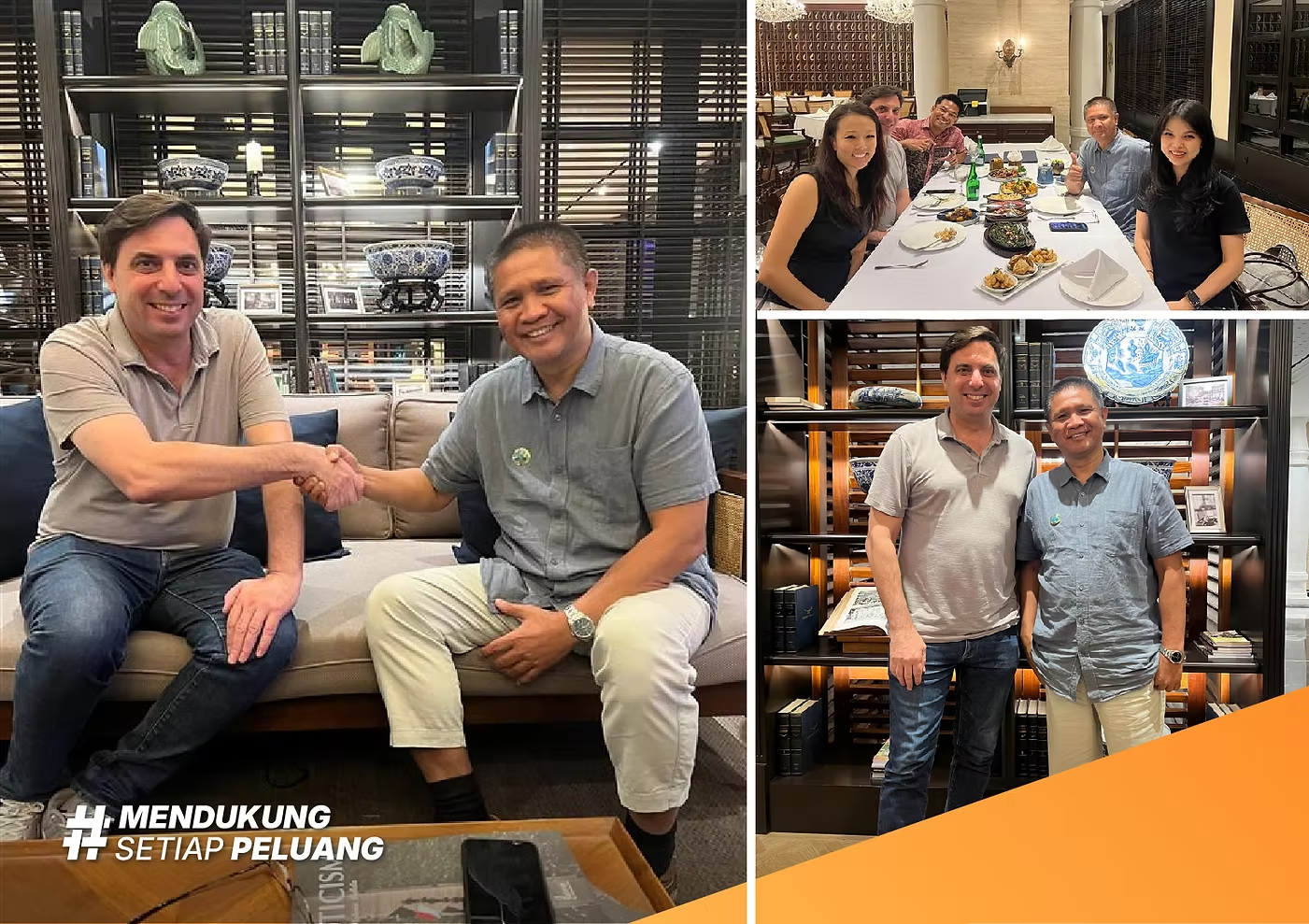
It all started when Emmanuel Van De Geer, CEO of Labamu, met with Mr. Abdul Sobur, founder of PT Kriya Nusantara and Chairman of HIMKI. The company is known as a premium furniture and crafts company with clients in Europe, the Middle East, and the United States.
This global reputation was built upon artistic expertise passed down through decades. However, behind this achievement lay a significant challenge: the absence of a modern, integrated manufacturing system.
Mr. Sobur saw an urgent need to organize production more efficiently. Without an MRP system, PT Kriya struggled to monitor production progress, manage inventory, and adjust capacity to meet growing export demand.
Responding to this challenge, the Labamu product team didn’t wait long. In just 48 hours, they successfully created an initial MRP prototype, which they immediately tested at PT Kriya. The response from Mr. Sobur and his team was overwhelmingly positive. This prototype demonstrated that local technology could truly address real needs in the field.
Thus, this collaboration is not merely a technology project, but rather co-creation in the true sense of the word.
Labamu brings expertise in software, system design, and a simple yet powerful user experience. Meanwhile, PT Kriya contributes field knowledge, including artisan workflows, production challenges, and export quality standards.
Moreover, the Indonesian Furniture and Craft Industry Association (HIMKI) will expand its network to encourage greater adoption among local manufacturers.
The result is a synergy for purpose-driven manufacturing solutions, which not only supports PT Kriya’s growth, but also has the potential to set a new standard for the Indonesian furniture and craft industry.
Key Features of Labamu Manufacturing (MRP)
Labamu Manufacturing is not just ordinary software. It is designed as a modular,
1. Production Tracking and Automation
- Digitizing traditional workflows.
- Providing real-time visibility into production progress.
2. Environment Modularity
- Connecting various stages, such as Dev, Staging, Pre-Prod, and Production, for smoother transitions.
3. Infrastructure-as-Code
- Utilizing Terraform and Jenkins pipelines for auditable infrastructure provisioning.
4. Secure Operations
- Relying on Pritunl VPN for private access.
- System secrets are automatically managed via Vault Agent Injector.
5. Scalable Service Components
- Redis for performance caching.
- Kubernetes (EKS) for workloads with autoscaling.
All these key features are made possible by the underlying technology, namely:
- Backend: GoLang.
- Dashboard: React for user-friendly display.
- GitOps: ArgoCD for automatic synchronization.
- Monitoring: Redis scaling and Jenkins monitoring.
Who is Labamu Manufacturing for?

The Labamu Manufacturing feature is suitable for use by:
1. Factory Managers and Operations Leaders
- Need real-time visibility.
- Aim to reduce manual workload.
- Appreciate a secure and stable system.
2. IT and DevOps Engineers
- Managing pipelines and deployments.
- Ensuring the security of system secrets.
- Managing cloud-based infrastructure.
Tangible Impact of this Feature for MSMEs
This manufacturing feature will be launched soon, but its impact is already visible in the pilot phase. Through the HIMKI network, this feature will:
- Helping craftsmen from Jepara, Bandung, Cirebon, to Bali.
- Increasing production efficiency.
- Ensuring timely fulfillment of export orders.
- Providing equal access to technology previously only enjoyed by large enterprises.
For MSMEs, this means an opportunity to move up a level. MSMEs that were once home-based businesses can become global players confidently serving markets in Europe, the Middle East, and even the United States.
So, if you are an MSME owner, furniture manufacturer, or craftsman, now is the time to start thinking about whether your manufacturing system is efficient enough to compete.
The collaboration between Labamu, PT Kriya Nusantara, and HIMKI proves that digital transformation isn’t meant to replace tradition, but rather to strengthen it. With the right technology, Indonesia’s craft heritage can thrive without losing its identity.
After learning what manufacturing is and how Labamu Manufacturing (MRP) can change the way MSMEs in Indonesia work, now is the time for you to start making changes in the business you run.
If you want a more efficient manufacturing business, ready for export, and on par with large companies, download the Labamu app on the App Store or Play Store to experience the benefits of Labamu Manufacturing’s features firsthand.