
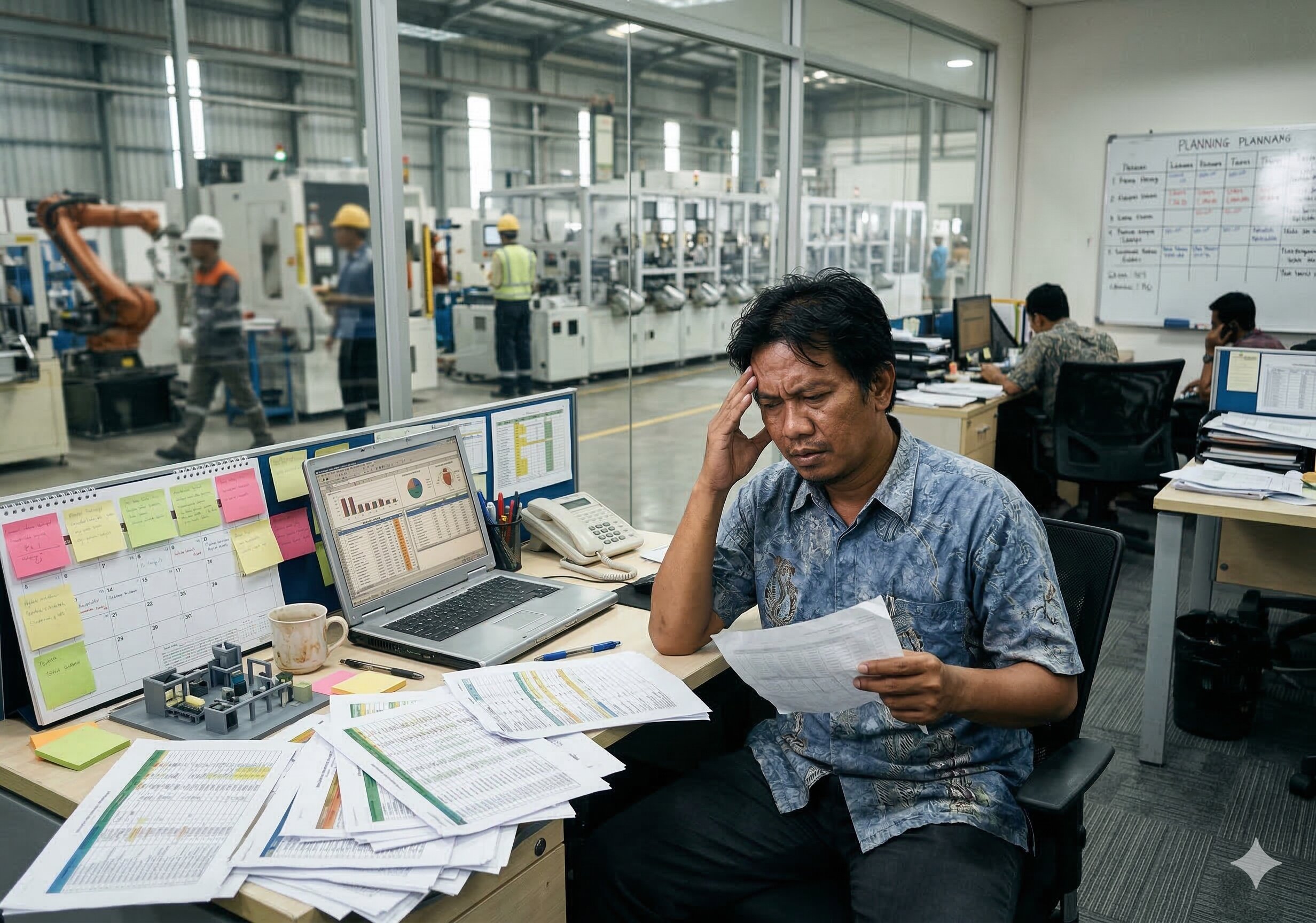
Many companies still rely on conventional MRP built for a time when demand was stable and changes were rare. However, today’s production reality is completely different: orders change quickly, suppliers are not always on time, and production processes are increasingly complex.
It is at this point that many teams begin to see that the old MRP is no longer supporting operations—but rather a source of bottlenecks that keep them from continuing to firefight.
And this is why systems like Labamu’s modern MRP are starting to emerge as the new answer.

Old MRP is Too Rigid and Not Adaptive
Old generation MRP is unable to adapt when:
- forecast changes,
- capacity changes,
- new order coming in,
- supplier delays,
- or the output is not according to plan.
Changes must be made manually, usually using additional spreadsheets. The company ended up running with a plan that was no longer valid.
MRP Labamu answers this pain with an end-to-end automatic flow — from RFQ, Quote, Purchase Order, to Work Order — without having to update manually. The system automatically adjusts documents and workflows when changes occur.
Data is still scattered and out of sync
Legacy MRP was not built for integration. As a result, the data is split:
- Sales have their own numbers
- Inventory has its own records
- Procurement has its own Excel
- Production has its own version
Data silos like this make decision making full of uncertainty.
Labamu MRP combines all data in one integrated workflow so that information is always real-time and consistent from request to production.
No Production Execution Control
The old MRP was just planning. Once a Work Order is created, the system does not monitor:
- routing stages,
- work status,
- actual progress of each stage,
- capacity changes,
- daily bottleneck.
Modern production requires visibility, not just plans.
MRP Labamu has routing stage tracking (Yet to Start, In Progress, Completed) so that the company can monitor every step of production execution in real-time.
Inventory is not batch based and has minimal traceability
Many operational problems arise because the old MRP only recognizes quantity figures. Even though modern industry requires:
- batch number,
- expiry date,
- vendor origin,
- material status (requested, expected, delayed, received),
- batch priority.
Without batch awareness, the risk of picking errors, quality and tracing problems is very high.
MRP Labamu provides complete batch-aware inventory, so that traceability and quality can be maintained from start to finish.
Workflow is still manual and not standardized
Flows such as RFQ → Quote → PO → Production are often still done manually:
- send email,
- copy paste Excel,
- chat approval,
- scattered documents.
Manual processes like this are error-prone, slow, and not scalable.
MRP Labamu solves this problem with workflow automation, including approval rules and auto-conversion between documents, so that the process becomes faster and more accurate.
No Material Blocking and Proper Material Allocation
Without blocking material, production can continue even if stock is incomplete. This causes:
- WIP accumulates,
- Rework increases,
- Late output,
- Wasted capacity.
MRP Labamu has a Material Allocation Gate, which ensures production only runs when materials are actually available and allocated.
Conclusion: Old MRP is Not Suitable for Modern Production Needs
Daily operational problems are not caused by the team, but by a system that no longer keeps up with current industry dynamics. Businesses need an MRP that:
- adaptive,
- integrated,
- batch-aware,
- real time,
- automatic, and
- supports end-to-end production execution.
Labamu MRP was built to answer all these pain points, presenting a new approach that not only plans, but also orchestrates the entire production process.
See How Labamu MRP Changes the Way You Produce
If your business is starting to feel the limitations of old MRP—data silos, manual workflows, inventory that is not batch aware, and planning that is not in sync with execution—then it’s time to see how modern systems work.
Labamu MRP offers automated workflows, complete batch tracking, routing stage monitoring, and real-time material allocation in one integrated platform.
Want to see how it works in the context of your business? Click here to get started