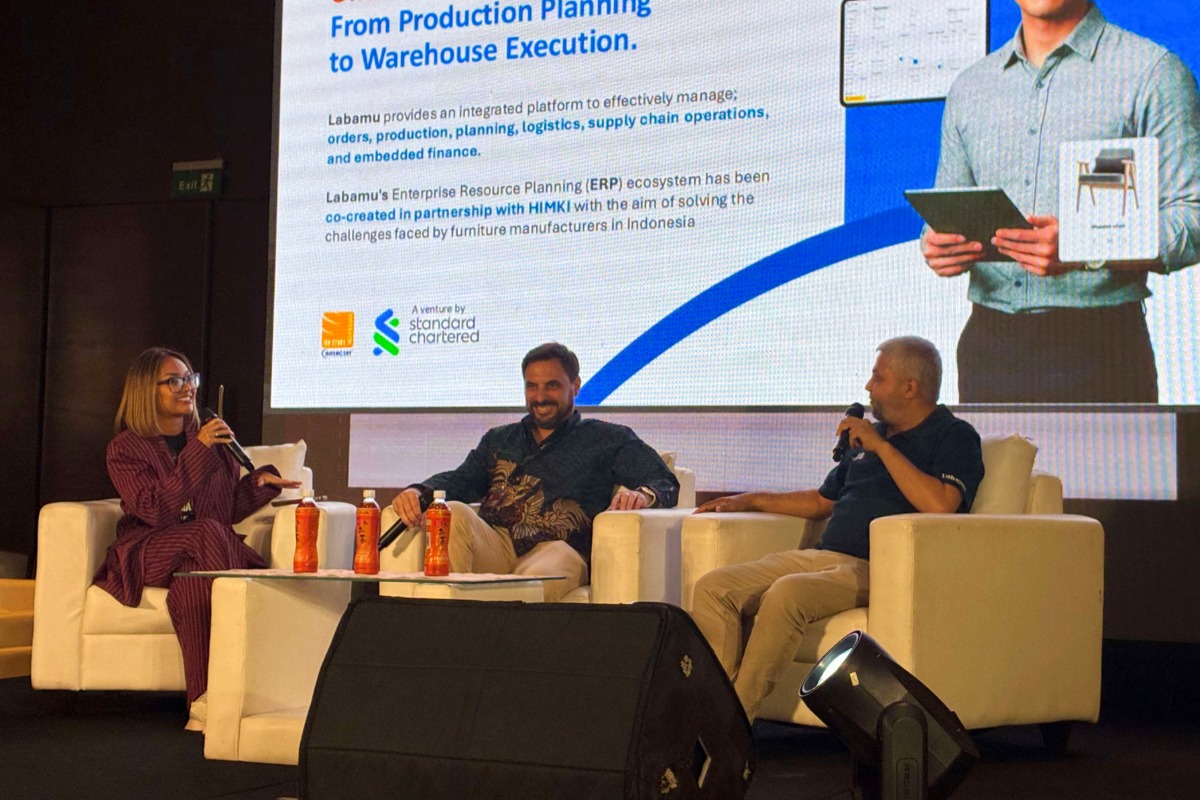
The way retail and F&B businesses in Indonesia make decisions is changing. Operational data that previously only accumulated is now starting to be processed into real action directions, supported by a combination of Enterprise Resource Planning (ERP) systems and artificial intelligence. This topic was highlighted at the B2B Tech Asia Expo 2026 panel, the first largest B2B business software exhibition in Indonesia, which took place 1-2 July 2026 at AXA Tower, Kuningan City Grand Ballroom, Jakarta.
In a session entitled “The Future of Retail Operations: How ERP and Autonomous AI Are Reshaping the Enterprise”, two of Labamu’s founders, Emmanuel van de Geer (Founder and CEO) and Kamal Shivdasani (Co-Founder and COO), shared views on how integrated technology helps businesses make faster decisions and operate smarter.
From collecting data to processing it into decisions
Emmanuel opens with a fundamental shift. According to him, today’s business challenge is no longer about collecting data, but turning it into actionable insights.
“Today’s organizations generate enormous amounts of operational data. The challenge is no longer collecting that data, but turning it into actionable insights so businesses respond faster, operate smarter, and serve customers better,” said Emmanuel.
He added that the way customers interact with technology is also changing rapidly. Labamu responded to this by connecting its services to AI assistants, so users can interact with the system more naturally, without having to navigate through multiple menus or search for information one by one.
AI as Decision Support, Not a Replacement for Humans
Kamal highlighted that amidst the emergence of AI, businesses still need the ability to make real-time decisions. Technology is here to strengthen this capability, especially in daily operations such as stock management, billing and inventory recording.
For Kamal, the real value of AI emerges when this technology helps businesses focus on what really drives revenue, while making repetitive operational work lighter and more efficient.
Customer Retention: A Huge Opportunity That’s Often Missed
One of Emmanuel’s interesting insights relates to F&B business patterns. Many restaurants are busy in the early months, then slowly lose momentum due to a lack of maintaining relationships with existing customers.
This is where technology comes into play. Emmanuel gave an example of using AI to create highly personalized retention messages, for example inviting old customers back to become active customers through relevant and targeted messages. This approach helps businesses maintain customer loyalty in a more measurable way.
MSMEs are the Backbone of the Indonesian Economy
Emmanuel also emphasized Indonesia’s unique position, where small and medium businesses contribute a large share of gross domestic product as well as employment. According to him, focusing technological innovation on this segment is the key to Indonesia’s economic future.
Kamal complements with highlights about the potential of local brands. He assesses that the quality of Indonesian products is very good, but many brands are not yet widely known in the global market. He encouraged business actors to start thinking on a global scale and build readiness to get there.
One piece of advice for business people in the AI era
Closing the session, the two shared practical advice. Emmanuel emphasizes two things: always talking to customers, both existing and potential customers, to understand their expectations, and taking special time to learn because technology changes very quickly.
Kamal closed with a simple but strong invitation: business actors need to have the courage to adopt, learn and develop. Instead of being hesitant about new technology, the key is to get started.
Translating Vision into Real Operations
The views shared on stage are in line with Labamu’s product direction. As an integrated ERP and business management platform, Labamu helps small and medium businesses manage operations, sales, inventory, finance, production and customer relationships in one system.
For F&B businesses, the Restaurant Management System (RMS) unites billing, payment, dish, kitchen and table management in one coordinated flow. For the manufacturing sector, Labamu Manufacturing integrates production planning, procurement, inventory management, warehousing, distribution and reporting in one system that provides comprehensive visibility.
“B2B Tech Asia is an important platform for industry players to exchange ideas, share best practices, and explore how technology can answer real business challenges. For Labamu, our goal is not only to provide software solutions, but also to actively contribute to building a stronger and digital-ready business ecosystem,” said Kamal.
Through the #GrowthSimplified mission, Labamu continues to focus on providing solutions that simplify operational complexity, so that businesses can make better decisions and grow with confidence.
Further information about Labamu solutions is available atlabamu.co.id.