

Small industrial villages are the heart of Indonesia’s current popular economy. You may often see a group of craftsmen gathered in one area. This is what we call an SME cluster or production center. They work together to increase the competitiveness of local markets. However, operational challenges often hinder their large-scale growth.
What is a Small Industrial Village?
- Core Definition: Residential area integrated with home industrial production facilities.
- Main Goal: Increase local supply chain efficiency through a collective collaboration system.
- Modern Solution: Use of digital platforms such as Labamu Manufacturing to standardize product quality.
Before we discuss the technical development of this area in more depth, it is important for you to start considering digitizing the production system through Labamu Manufacturing so that stock management is more measurable and efficient.
Definition and Strategic Role of Small Industrial Villages (PIK)
Small industrial villages are special areas for small entrepreneurs. Governments usually design these areas to concentrate production activities. The most popular example of a small industrial village is the PIK Pulogadung location. There, thousands of MSMEs work together in one large ecosystem.

This area is not just a place to live for business owners. It is an organized home industry coaching center. In this area, there are usually production cooperatives that help members. They facilitate the procurement of raw materials at more affordable prices. This creates economic stability for all craftsmen in it.
The benefits of small industrial clusters are felt in the savings in logistics costs. Because production locations are close together, distribution of goods is much faster. You can share resources with fellow creative industry players. This collaboration strengthens the bargaining position of MSMEs in the eyes of large buyers. This is the main essence of sustainable industrial MSME empowerment.
Evolution of Industrial Clusters: From Conventional to Digital Ecosystems
Conventional methods in managing craft centers are now starting to become outdated. In the past, entrepreneurs only relied on manual recording in ledgers. This often triggers errors in finished goods stock data. Lack of visibility means that the production chain often stops suddenly. You need a new method that is smarter and more accurate.
Here is a comparison between the old method and the modern digital system:
| Management Features | Conventional (Old) Method | Digital Ecosystem (Labamu) |
| Stock Recording | Manual, data discrepancies often occur. | Automatic and tracked in real-time. |
| Production Planning | Just based on instinct or guesswork. | Data-driven, accurate, and planned. |
| Access to Financing | Difficult because financial data is not neat. | Connect to a global partner network. |
| Business Visibility | Must physically check at the warehouse every time. | Monitor everything from one dashboard. |
Digitalization is changing the face of small industrial villages to become more professional. With an integrated system, every craftsman can maintain quality standards. This standardization is very important if you want to penetrate the international market. Without valid data, it is impossible for MSMEs to advance to class. This transformation is the key to surviving in the industrial era 4.0.
Tactical Steps to Develop Industrial Centers Go Digital
Developing small industrial villages towards digital requires concrete steps. You don’t need to start everything from scratch with everything complicated. The first step is to unite the vision between home industry owners. Collectivity is the main force in the current popular economic system.
Use Labamu Manufacturing to manage integrated sales management independently. You can track the entire sales process from start to finish. Starting from offering prices to potential buyers to product delivery. Everything is clearly recorded in a secure and practical cloud system. Data transparency will increase buyers’ trust in your industrial products.
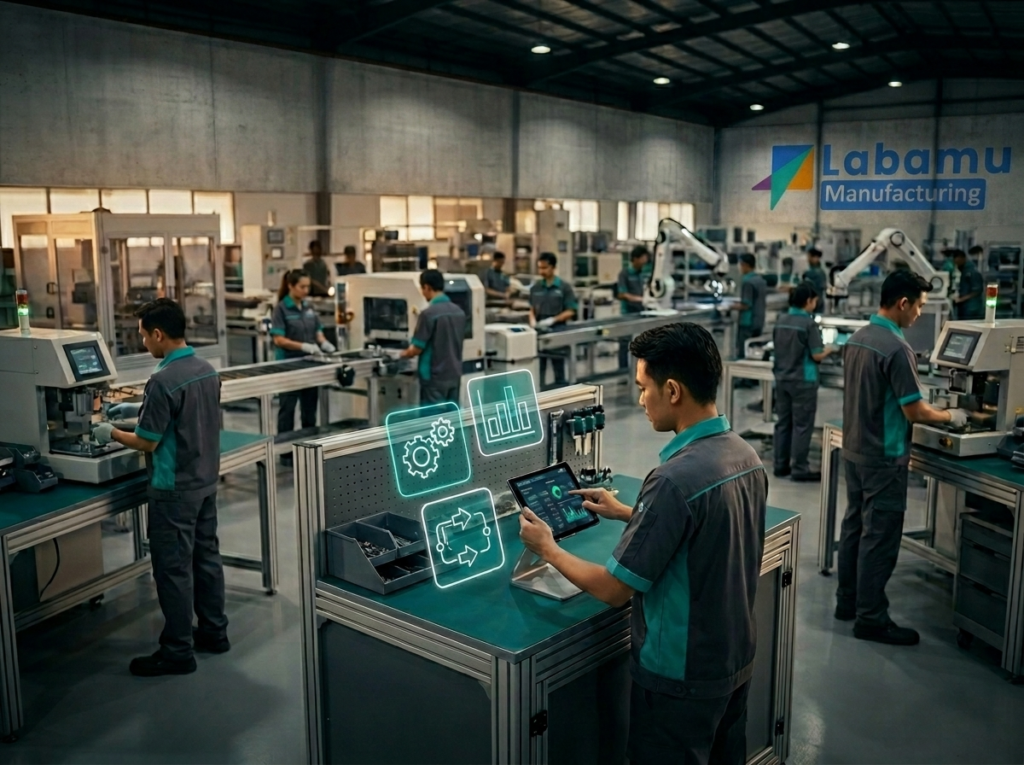
Second, apply accurate production planning for every incoming order. Don’t let production machines stop due to a sudden shortage of raw materials. With Labamu, you can monitor each production order in detail. Ensure the process runs on time without any significant operational obstacles. This efficiency will immediately have a positive impact on the profitability of your business.
Third, optimize automatic stock management to maintain the availability of finished goods. Manage raw material inventory with a highly intelligent tracking system. This system is integrated directly into ongoing production orders. You will get a warning if stock starts to run low automatically. This helps you avoid the risk of missing out on valuable sales opportunities.
Integrating Local Supply Chains Through Collective Collaboration
The main strength of a small industrial village lies in the synergy between its members. You can build a very strong and independent local supply chain. One MSME can provide raw materials for other MSMEs. This creates a healthy circulation of money within the region. Production cooperatives play a crucial role as a bridge for entrepreneurs.
In a digital ecosystem, this collaboration can be monitored through full control visibility. One dashboard allows you to monitor all production and sales activities. You can make business decisions more quickly and very accurately. There is no longer any doubt in determining the next step for market expansion. All data is presented transparently to support collective regional growth.
In addition, access to global financing is now easier to reach. Your profits help you connect with a wide network of international trading partners. You can get financing support in more than 70 trade corridors. This opens up opportunities for craft centers to export. Business capital is no longer the main obstacle to the progress of MSMEs.
Maintaining Product Quality Standards Through Digital Stock Management
Quality standardization is the biggest challenge in small-scale mass production. Small industrial villages often face the problem of inconsistency in the final product produced. Consumers demand the same quality in every purchase they make. This is where the role of stock management technology becomes very vital and crucial.
With an automatic tracking system, you can control the quality of incoming raw materials. Ensure that only the best raw materials are used in the daily production process. The history of each production batch can be traced in great detail and clearly. If a problem occurs, you can find the source of the error very quickly. Maximum operational efficiency will be achieved through reducing the risk of manual errors.
Finally, total visibility provides complete control over the running of the entire industrial business. You know exactly when to add workers or machines. Data-based decision making will ensure long-term business sustainability. Let’s bring local Indonesian products to compete on the world stage with pride. Start your transformation steps now with advanced features from Labamu Manufacturing.
A Bright Future for Community Industry Through Technological Innovation
Building a resilient industry starts with the courage to adopt innovation. Small industrial villages have great potential to become new economic centers. Collaboration, digitalization and commitment to quality are the keys to mutual success. With the right tools, capital and market access limitations can be overcome. Let’s make our home industry a symbol of national independence.